Blue Note Records: The Jazz Label Behind Blue Train, The Sidewinder and a Holiday Knit

On March 3, 1939, a small New York label put out its first release. The recordings behind it came from a single day in a rented studio, with two boogie-woogie pianists, Albert Ammons and Meade Lux Lewis, at the keys. That label was Blue Note Records, and more than eight decades later its name still means something to anyone who has ever put on a jazz record.
If the name is familiar but the story is not, this is a quick guide: where Blue Note came from, why its records sound and look the way they do, where to start listening, and one cosy way to wear the name this winter.
Who started Blue Note Records?
Blue Note was founded in New York City in 1939 by Alfred Lion and Max Margulis, both German-Jewish emigrants. The name comes from the "blue notes" of jazz and the blues, the bent, aching notes that give the music its colour.
Not long after, Lion was joined by his childhood friend Francis Wolff, a professional photographer who emigrated at the end of 1939. Wolff photographed the label's sessions, and his pictures of musicians at work turned up again and again on the record sleeves. He stayed with Blue Note until his death in March 1971.
The label's first hit came early: Sidney Bechet's "Summertime".
How did the Blue Note sound take shape?
In the 1940s Blue Note recorded traditional jazz and small-group swing, released on 78 rpm records. From 1947 it turned toward modern jazz, the same year Thelonious Monk made his first sessions for the label. The first 10-inch LPs arrived in 1951.
Then came the piece that defined the sound. From 1953, most Blue Note releases were recorded by engineer Rudy Van Gelder, whose studio sat in Hackensack, New Jersey. The label became associated above all with hard bop, and its roster from those years reads like a who's who of the music:
- Horace Silver
- Art Blakey
- Lee Morgan
- Jimmy Smith
- Freddie Hubbard
- Hank Mobley
- Wayne Shorter
- Grant Green
- Jackie McLean
- Bobby Hutcherson
Why do people talk about the covers?
For many listeners, Blue Note is something you recognise before you hear it. In 1956 the label hired Reid Miles from Esquire to design its covers, and he stayed until late 1967. His sleeves paired tinted black-and-white photographs, very often Wolff's own session shots, with bold blocks of colour, and they became some of the most recognisable images in jazz. Cool Struttin' and Midnight Blue are two that still get singled out.
That look is a big part of why the Blue Note name works so well away from the turntable: it already reads as a style, not just a label.
Which Blue Note records should you start with?
If you are new to the catalogue, a handful of albums make a friendly way in:
- Blue Train by John Coltrane, a hard bop landmark.
- Somethin' Else by Cannonball Adderley, smooth and easy to love on a first listen.
- The Sidewinder by Lee Morgan, whose title track was a hit in the early 1960s.
- Song for My Father by Horace Silver, warm and melodic.
- Out to Lunch! by Eric Dolphy, for when you want something more adventurous.
Put any of those on and you will hear why the label's reputation has lasted.
What happened to Blue Note after the classic years?
The story did not end in the 1960s. The label was sold to Liberty Records in the mid-1960s, and Liberty merged into United Artists Records in 1968. EMI bought United Artists in 1979 and phased Blue Note out, but in 1985 it was relaunched under EMI Manhattan, led by Bruce Lundvall.
The relaunch carried the name into a new era, with later signings including Norah Jones, Joe Lovano and Jason Moran. The Blue Note Label Group was created in 2006, the label is now part of Universal Music Group under Capitol Music Group, and Don Was has been its president since January 2012.
If you want the longer version, the Blue Note Records story from 1939 to now goes deeper into each of those chapters.
A Blue Note piece for the cold months
All of that history makes the label's holiday design a fun surprise. The Blue Note Records Holiday Knit sets the name in bold red capitals, framed like a classic Christmas sweater, between rows of green pixel trees, red diamonds and red and green zigzag borders. On the back, a row of red pixel gift boxes runs along the foot above a green zigzag trim, with the rest left clear.
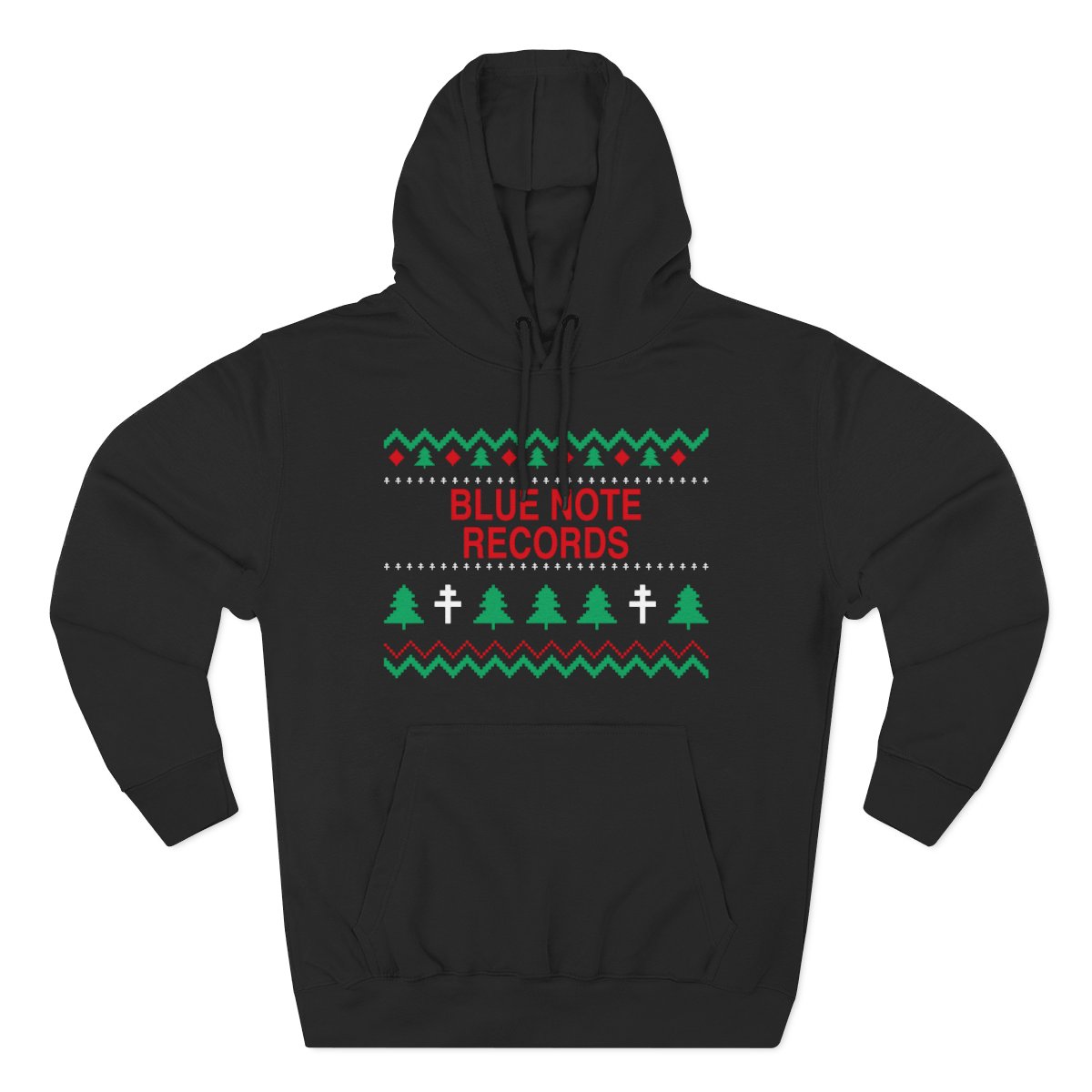
It comes on a three-panel fleece hoodie, a heavy blend crewneck, and youth crewneck and hoodie sizes, so the whole family can match on a winter morning with a record playing.
It also sits nicely beside our own Blur Christmas Knit, which puts the Blur name in red capitals inside a festive pattern of green zigzags, red diamonds and trees. Two very different sounds, one shared love of a proper holiday sweater, and the full Blur Christmas range is waiting in our shop when you are ready to pick yours.